What You Can Do to Help with Brief Record Cleanup


By Erica Laughlin, Bibliographic Services Manager

As you might have read in a previous RSA newsletter or heard at a recent Directors Advisory Committee (DAC) meeting or Cataloging Chat, RSA has started working with SirsiDynix to clean up some of the approximately 58,000 brief records in WorkFlows. These brief records make up 5.5% of the approximately 1,054,000 total bibliographic records.

There are too many brief records for the RSA Bibliographic Services Department to upgrade manually one-by-one. That approach would take over 30 years! The goal of the large-scale brief record cleanup is not only to enhance the bibliographic quality of our database, but also to improve discoverability and reciprocity in WorkFlows and the RSAcat. Discoverability and reciprocity are two of the RSA core principles.

Here are five things your library can do to help with brief record cleanup:

  1. Review reports of your library’s brief items that have never checked out or not in the past ten years.
    Zac from the RSA Bibliographic Services Department is reaching out to libraries to ask them to check their shelves and consider removing two types of brief items:
    Those brief items that have never checked out in WorkFlows
    Those brief items that have not checked out in the past ten years since January 1, 2016
    You will receive (or may have already received) an email from Zac if your library has any brief items that fit these criteria. If the items are not missing or lost, RSA can batch remove them from WorkFlows if you have the Director’s permission.
    Some brief items, such as equipment, reference, and special collections, are in-library use only and may not check out. Even if you plan to keep these items, checking your collection to ensure you still have them and discarding them if not would be a good idea.
    At the recent DAC meeting on July 8th, helpful feedback was shared about the report of brief items that have never checked out. Some of the items listed on that report have never checked out because they were recently cataloged.
    In response to the DAC’s feedback, RSA has adjusted the criteria for the never checked out report to exclude recently cataloged brief items that may not have had a chance to check out yet. The report excludes from its output items cataloged in the past thirteen months. That timeframe was chosen because that is the length of time RSA considers an item new for our de-newing process that batch edits new item types to standard ones.
    Thank you to the DAC for their feedback about this report. If you would like an updated report of your library’s brief items that have never checked out so it excludes items cataloged in the past 13 months, please reach out to .

  2. Request a report of your library’s brief items that may be eligible for Cataloging Maintenance Center (CMC) cataloging.
    The RSA Bibliographic Services Department can create a list of the genealogy and local history items in your collection that may be eligible for free CMC cataloging service. Email if you are interested in a report of your items that are potentially CMC eligible. RSA will create the list and email it back to you. For any items you decide to submit to the CMC, look at the “Sending an Item to the CMC” section on the CMC home page. The CMC will let RSA know when the OCLC record for your genealogy or local history item is ready to load into WorkFlows, overlaying the brief record.

  3. Always check WorkFlows first and then OCLC (if your library uses Connexion Client or Record Manager) before creating a brief record to ensure there is no matching record already available.
    Searching WorkFlows and OCLC (if your library uses it) before entering the brief record is crucial to avoid creating a duplicate record for an item that already has a matching record. Duplicate records are not only confusing when searching in WorkFlows and the RSAcat, but they also spread holds across multiple records, resulting in holds taking longer to fill and patrons waiting longer to receive items.

  4. When creating a brief record, always enter the ISBN, ISSN, or UPC if the item has one.
    Entering an ISBN, ISSN, or UPC (referred to as a “standard number”) on the brief record is critical. The standard number provides a valuable match point as RSA continues large-scale cleanup, transferring brief items onto OCLC records in WorkFlows that match based on title, author, and standard number. Entering the standard number on the brief record will also be very useful when RSA uses a third-party tool to batch search OCLC for matching records.

  5. This Fall watch for RSA to send you a report of your library’s brief records without standard numbers.
    Brief records without standard numbers are not only difficult to search, but they are also impossible for RSA’s large-scale processing to merge duplicates and transfer brief items to matching OCLC records.
    This Fall RSA will be reaching out to libraries that have items cataloged on brief records without standard numbers. If you have any of these records, RSA would appreciate your help looking for these items on the shelf, seeing if they have a standard number, and if so, entering the standard number into the report and emailing it back to the RSA Help Desk. RSA will add the standard numbers to the brief records so they can be considered during the next run of processing.


    Questions about RSA’s brief record cleanup or what you can do to help? Reach out to or 1-866-940-4083.

It’s IPLAR Season!

It’s IPLAR Season!

By Patty Kweram, Library Services Coordinator

Not only is it Summer Reading season, it’s also IPLAR season! For many of you, the fiscal year just ended, which means it’s time to complete the Illinois Public Library Annual Report.

RSA has created a guide to completing the relevant circulation and collection questions on the IPLAR. Some of the data is emailed to your RSA-provided email account hosted by IONOS. Look for the reports dated the 1st of the month that begins your fiscal year. Example: reports dated July 1, 2026, for a fiscal year from July – June. Other data is compiled on the RSA Support Site Monthly Statistics Page. Specific reports and where to find them are in the above linked instructions.

Digital Circulation Statistics ADML (Overdrive/Libby) and eRead Illinois (Palace Project), circulation data is found on the Monthly Statistics Page.

You may also use the statistics reports in the admin sites for Palace Project and for Overdrive/Libby. Boundless data (2025) is only accessible on the monthly statistics page.

The State Library provides these resources: Illinois State Library IPLAR portal.

Contact Counting Opinions for technical assistance at or by phone 1-866-285-1950. For non-technical questions, please contact the Illinois State Library at or by phone at 1-800-665-5576, extension 2.

Laura Keyes, Library program Specialist, can be reached at 217.785.1168 or

Ever wonder why some patron records take longer than others to load in WorkFlows?

Managing Charge History in Patron Accounts

By Sara Naslund, Library Services Coordinator

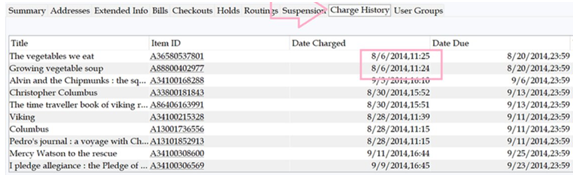
Ever wonder why some patron records take longer than others to load? Get the blue circle of death when trying to look at a Display User? It could be due to Charge History. The more items in a patron’s charge history, the longer it takes to load their account.

This patron has every check out since 2014 recorded. As you can imagine, that is a lot of information to load every time they are looked up.


Want to fix that? Email the Help Desk and give us a date (i.e. Remove everything prior to 2020) and we can delete portions of the history.

Want to fix that? Here is how to do that!

Working on the IPLAR? We have some of your stats!

While we can’t help with things like computer use counts and programming numbers, there ARE quite a few stats RSA can help you with. Find that information here:

And here’s a handy direct link to monthly statistics for circulation, including Palace Project/eRead Illinois and ADML/Overdrive: https://support.librariesofrsa.org/project/monthly-reports/

Find your library in the list and grab your stats!

Important Dates for School Libraries

Reminder for schools, please review the dates and actions outlined in the emails sent to the school email forum by Antony. The subject was RSA School Staff: REMINDER: Dates and Reminders for the End of the 2025/2026 School Year and was last sent on Wednesday the 22nd. Contact the RSA Help Desk if you didn’t receive these emails.

In short, those important dates are:

Friday, May 8th – No new holds can be placed for pickup at school libraries.

Friday, May 15th – Outstanding holds for pickup at school libraries will be removed. Contact the RSA Help Desk if your library will be providing services after Friday, May 15th and needs to continue to place/receive holds.

Friday, May 15th – The default End of Semester (EOS) dates for ALL school libraries who use them are set to May 15th. Checkouts with due dates later than the EOS date will have their due date shortened to the EOS date. If you need a different date and haven’t already contacted us, please email the RSA Help Desk or give us a call.

Friday, May 15th – Outstanding holds for pickup at school libraries will be canceled and removed. Contact the RSA Help Desk to set up exceptions to these dates.

Friday, May 29th – Last delivery day to school libraries by RAILS delivery. Please email the RAILS Delivery Helpdesk at if you need service after this date.

Prior to the end of the school year – Backup your WorkFlows Configuration Folder onto a USB/flash drive. Instructions are here: https://support.librariesofrsa.org/project/setup-config-backup/#Backup_and_Restore . PLEASE ENSURE YOU DO THIS! If your computer is cleaned or replaced by IT over the summer, having a backup of your settings will save you about 30 to 40 minutes of work setting WorkFlows up from scratch.

Prior to the end of the school year – Submit your closure dates for the 2026/2027 school year via an email to the RSA Help Desk.

Starting May 1st until delivery resumes this fall – RSA’s Cataloging Department will not place holds on school items cataloged on brief records. We will resume upgrading these records to OCLC records in the fall.

Book Club FAQs

Whether you are reading historical fiction, fantasy, or biography, RSA best practices for book clubs shouldn’t be a mystery. Let’s take a look!

What profile should I use for my book club in WorkFlows? 

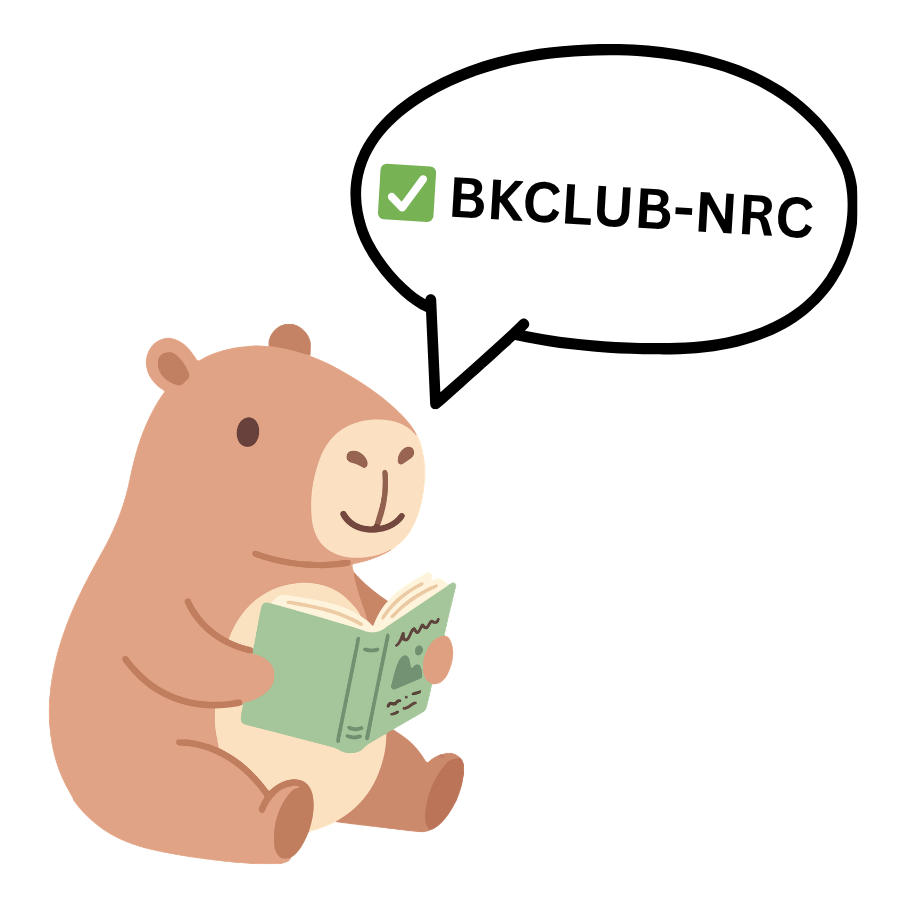
A capybara reading a book with a voice bubble reading "BKCLUB-NRC"

✅ BKCLUB-NRC 
BKCLUB-NRC is the recommended profile for book clubs. Check to make sure you’re using BKCLUB-NRC (and not BOOKCLUB*) Check the books out to your book club card first. Then check the items out to the individual patrons. 
 
*Why is there a BOOKCLUB profile if we are supposed to use BKCLUB-NRC? 
BOOKCLUB is a legacy profile that was set up to be recirculating. Recirculating allows books to be checked out twice (once to the book club profile, and then a second time to a patron.) In theory, this sounds convenient. But in real life, it didn’t work out to have a recirculating profile where you must check out a book twice AND return it twice (recirculating = too many ways to make mistakes!). Nowadays we don’t recommend using BOOKCLUB. Use BKCLUB-NRC instead! 

How can I make sure there are enough books in the system, and at the right time, for all my book club members? 

First, check WorkFlows to make sure there are enough copies in the system to fill all your club’s holds. Second, make sure it’s not a new book or an especially popular book, because high demand may prevent you from being able to fill all the holds. 

Finally, check to see if another library is using the same book club selection in the same month. Two or more libraries placing holds on the same book in the same month might mean there’s not enough to go around.

Luckily, there is a member-made tool for seeing what other RSA libraries are doing for their bookclubs: the RSA Book Groups wiki board, which was founded and is administered by RSA member Beth Duttlinger. We highly recommend joining the wiki if you haven’t already and updating it with your own book club information. 

By using the wiki, you can ensure your own book club always has enough copies of your chosen book and be a good citizen to other RSA libraries, so they know what book your library has selected as well. 

I’ve been putting each book on hold individually for my book club. Is there a faster way? 

Yes!!! There is a faster and easier way than making each hold individually. Did you know you can make blanket holds? Learn the procedures here: Placing-Book-Club-Classroom-or-Research-Holds-Guide-2024-12-02.pdf

Check your IP address to keep services running seamlessly

In preparation for launching RSA’s new firewall we are asking that staff at libraries update
their WorkFlows IP address configuration using the instructions in this cheat sheet: Updating
the WorkFlows IP Address Configuration.
If you update the IP address configuration to
workflows.librariesofrsa.org now you will have seamless access to WorkFlows once RSA
launches its new firewall. If you do not update the configuration, you may temporarily lose
access to WorkFlows once we change the firewall as the new firewall will have a new IP
address.

In addition, if you have self-check outs or other devices that have connections to SIP you
should update the IP address setting to sip.librariesofrsa.org

Third party vendors such as Hoopla, Palace Project, Overdrive, Find More Illinois and Freegal
have already been contacted by RSA and have already updated their settings.
If you have any questions about changing these settings, contact the RSA Help Desk at 866-
940-4083 and ask for James.

Spring Cataloging Training & Events

Banner: Spring Cataloging Events

RSA In-Person Basic WorkFlows Cataloging Workshop

Location: Prairie Creek Public Library District
Time: Thursday, April 30, 2026 | 12:00 pm – 4:00 pm

This workshop is helpful for new catalogers or existing catalogers in need of a refresher. Through hands-on practice, learn how to use WorkFlows to catalog items in a variety of formats. Create brief records for items that lack matching bibliographic records already in WorkFlows. Discover how to perform global item edits and use the discard account.

For full information and to register for Basic WorkFlows Cataloging Workshop, visit L2.

RSA Online Bibload Workshop

Location: Online (Microsoft Teams)
Time: Wednesday, May 13, 2026 | 9:30 am – 12:00 pm

The Bibload Workshop focuses on how to use OCLC Connexion Client to make bibliographic records usable for RSA, including how to add library-specific call number/item information to the records, export them from the Client in the correct format, and load them into WorkFlows so they are visible in the RSAcat. Any registrant not already using an individually named WorkFlows account to catalog at the OCLC level will receive one at the time of the workshop.


For full information and to register for Online Bibload Workshop Workshop, visit L2.

RSA Online Basic WorkFlows Cataloging Workshop

Location: Online (Microsoft Teams)
Time: Friday, May 22, 2026 | 9:00 am – 1:00 pm

This workshop is helpful for new catalogers or existing catalogers in need of a refresher. Through hands-on practice, learn how to use WorkFlows to catalog items in a variety of formats. Create brief records for items that lack matching bibliographic records already in WorkFlows. Discover how to perform global item edits and use the discard account.

For full information and to register for Basic WorkFlows Cataloging Workshop, visit L2.

RSA Cataloging Chat (In-person and Online)

Location: In-person at Chenoa Public Library District and Online (Microsoft Teams)
Time: Friday, May 29, 2026 | 10:30 am – 12:30 pm

Learn what’s new with the Cataloging Maintenance Center, RAILS Cataloging Services, and the RSA Bibliographic Services Department.

For full information and to register for Cataloging Chat, visit L2.